Dateline August 19, 2021, Pinehurst
We drove down from Raleigh to the Pinehurst Resort for the North-South Senior, a redo of last year. This time we decided to stay at one of the resort's own properties, the Holly Inn, a lovely place with a separate sitting room, set right beside the picturesque Village of Pinehurst. We had a fine time learning the history of the inn, and since we have written about Pinehurst before, we thought we might dwell on that history this go-round.
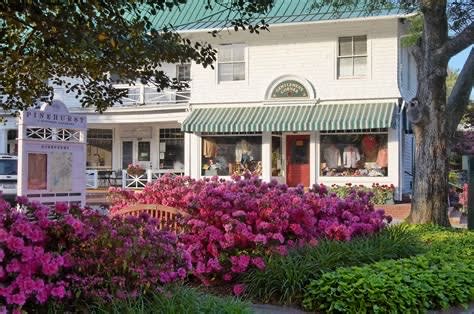
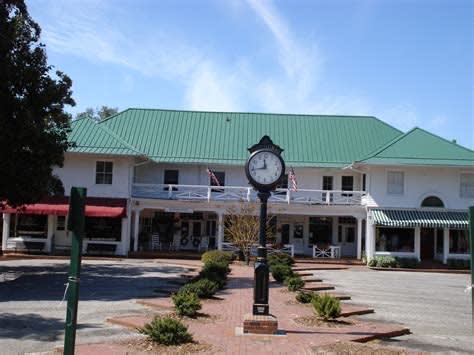
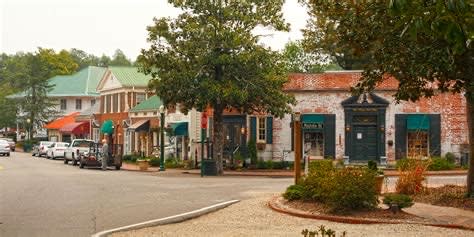
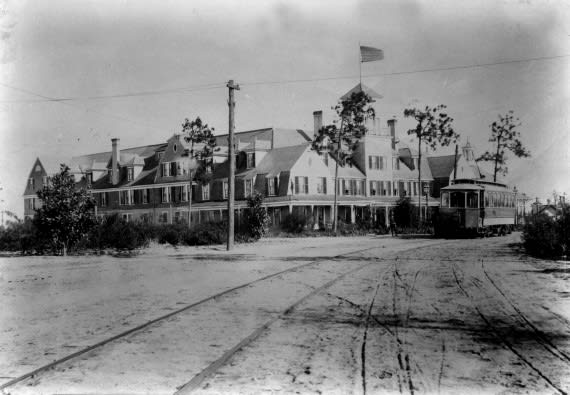
The Holly Inn. The Holly was the first hotel James Walker Tufts built when he founded Pinehurst, opening its doors on New Year's Eve, the last day of 1895. Tufts, who had made his fortune in soda-fountain machines, dreamed up Pinehurst as a retreat from the hard Northern winters, with a season that ran from the first of November to the end of April. That first night, twenty guests rang out the old year and rang in the new at three dollars a head. The prices have climbed since, but adjusted for inflation they come out about the same; three dollars a person, or six a couple, is roughly a hundred and ninety-five dollars today, close to what we paid, and we even got a to-go breakfast bag for the course.
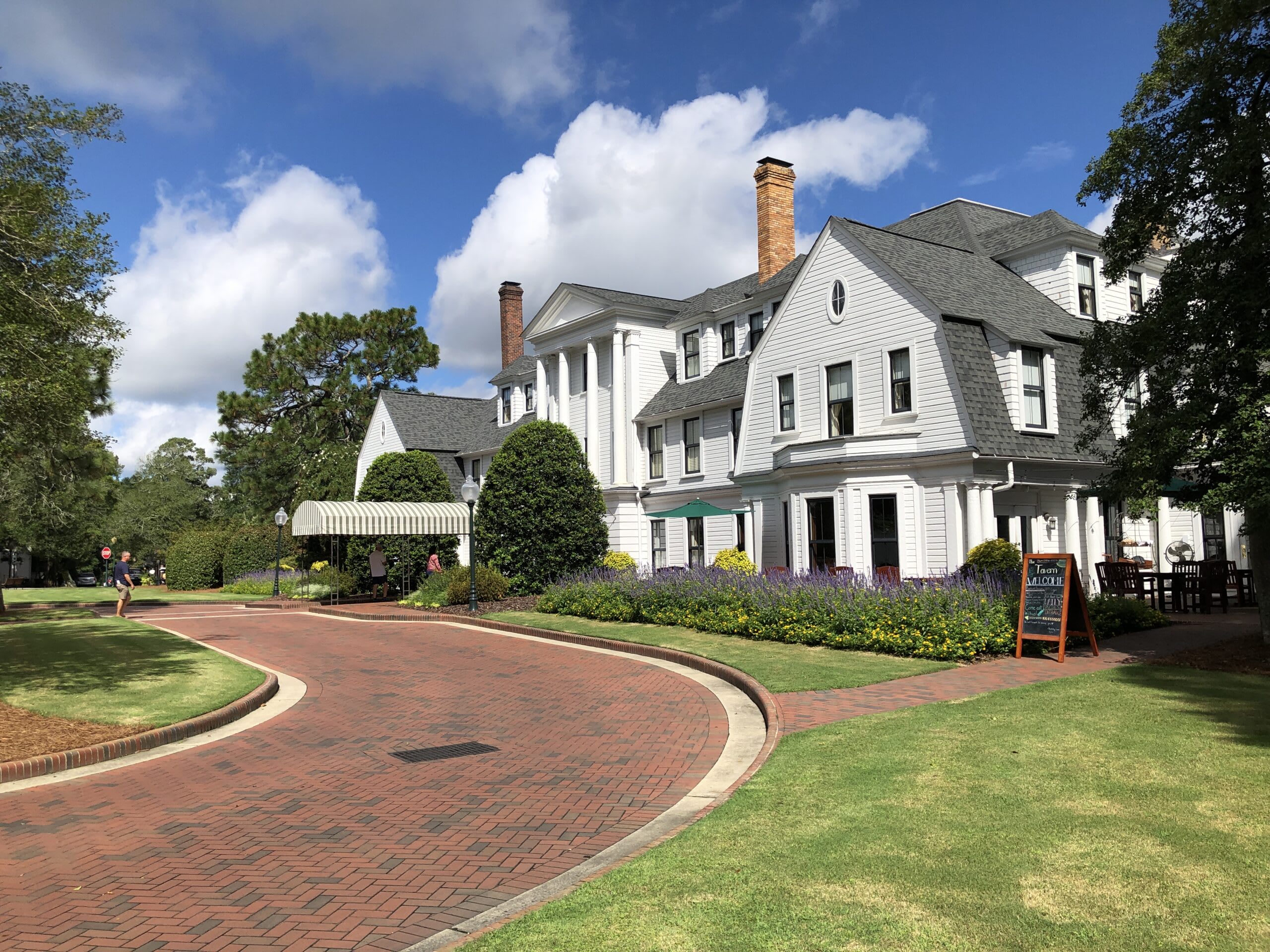
The inn mixes architectural styles, part Queen Anne Revival, part Arts and Crafts, part Art Nouveau, and somehow it all hangs together; we would just call it Victorian. The grounds run to abundant foliage and winding paths, with a pool around the back. In its early days the Holly boasted every modern amenity of the time, electric lights, steam heat, telephones, a solarium, a billiard room, and, in Tufts's own words, "the best quality of hair mattresses." Now that the golf season runs year-round, thank goodness, they have added air conditioning.
The inn has had its turns over the years. In 1943 it housed officers and their families when nearby Camp Mackall ran short on quarters. Then in the summer of 1944 it became the site of an Army study of the common cold, with conscientious objectors from Fort Bragg, men who had religious objections to the war, volunteering as the subjects, research sometimes called the Pinehurst Trials. There were no COVID studies going on during our stay, as far as we know. The Holly struggled in the 1970s as newer hotels drew the travelers away, and it closed for a time, its future uncertain, until a careful restoration brought it back in 1986. It is now a National and State Historic Landmark.
It was a real pleasure to stay there, and we would happily do it again.
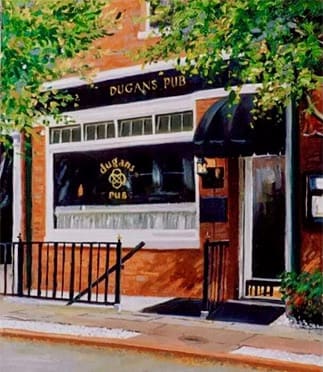
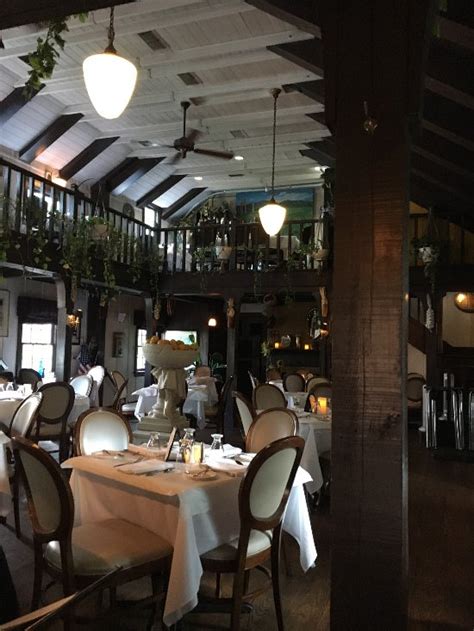
Dugan's Pub and Theos Taverna. We keep finding our way back to Dugan's Pub, a fine spot with reasonable prices. This time we caught up with two friends, Liz and Pat from the Jacksonville area, both in town to play the Veterans Golf Association National Championship. We had a beer together at Dugan's, and the next evening a wonderful dinner at Theos Taverna over in the village.

Is Pinehurst just one course? We got to talking with a cousin out in California who, like a good many people, supposed Pinehurst was a single course. The resort has nine. The famous one is No. 2, where the U.S. Open has been played three times since 1999. The first four, Nos. 1, 2, 3, and 4, were Donald Ross designs, with the rest done by other well-regarded architects, and there are another twenty or so courses around the area besides, many of those Ross's as well. The resort courses sit among the top hundred you can play, the public ones, on both the Golfweek and Golf Digest lists, and No. 4 was lately taken back to Ross's original design. We had the pleasure of playing three of them in the North-South Senior, Nos. 2, 5, and 8. What a treat.
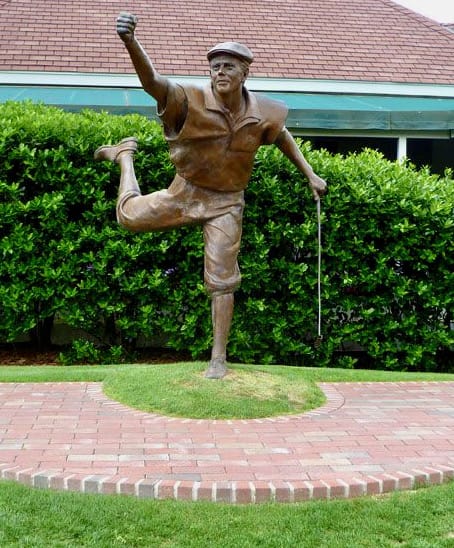
The bronze statues by the clubhouse. Outside the main clubhouse stand several bronzes worth a moment.
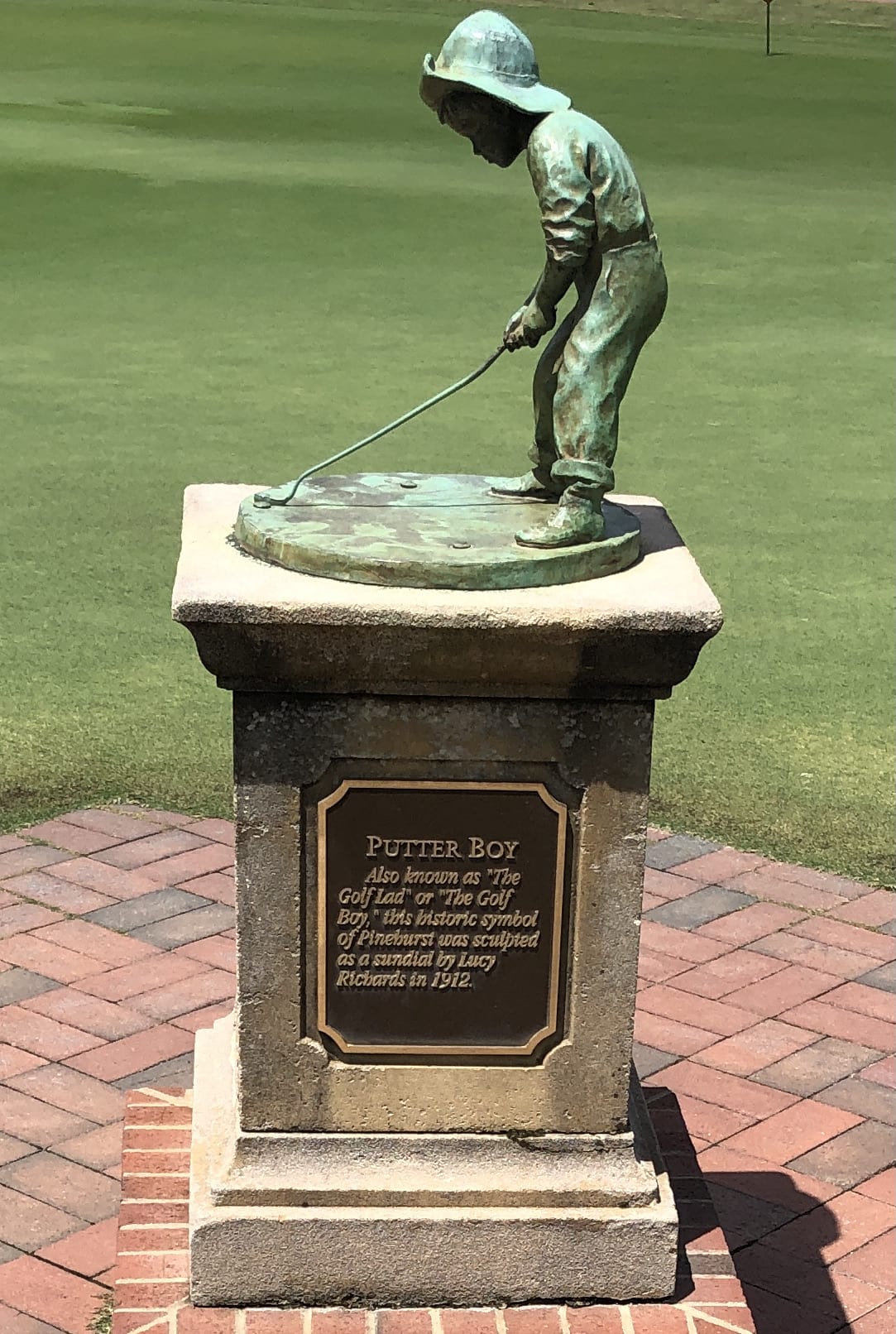
The Putter Boy. In 1912 the sculptress Lucy Richards used the resort's old advertising figure, the "Golf Lad," as the model for a bronze in the form of a sundial. Since she was not a golfer, Donald Ross showed her the proper grip and stance, though the figure is not Ross, who was a grown man by then. The shaft of the club casts the shadow that tells the time on the sundial, and to get the angle right it had to be made inordinately long. The statue was known as the Sundial Boy until the 1970s, when the name Putter Boy took hold. For years it sat between the two big putting greens beside the clubhouse; it was moved in 1978 to the World Golf Hall of Fame, came back to Pinehurst around 1990, and stands proudly out front once more.
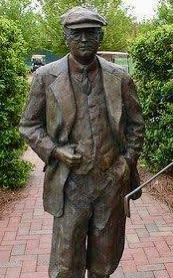
Donald Ross. This one honors Donald J. Ross, the father of American golf course architecture, who had charge of the course building, the upkeep, the golf shop, and the tournaments at Pinehurst from the early 1900s until his death in 1948. It was dedicated by his daughter, Lillian Ross Pippitt, at the Tour Championship on the first of November, 1991.
Payne Stewart. The larger-than-life statue overlooks the 18th hole of No. 2. Stewart won the 1999 U.S. Open there with a fifteen-foot par putt on the last green, beating Phil Mickelson by a single stroke, then leapt into his caddie's arms with one leg kicked back behind him, the very pose the sculptor caught. He died just four months later, at forty-two, when his plane went down. The statue was unveiled the day before the 2005 U.S. Open at Pinehurst, with a lone bagpiper playing three slow Scottish airs as he walked up the first fairway.
As for our own golf, it was a humbler affair. John was not feeling well enough to finish the third round, and Janice, we are pleased to report, had a good last day and was decidedly not DFL this year. We wrapped up on Wednesday and set off straightaway for the north, to see Janice's Aunt Margaret and Uncle Bill in Harwich, out on Cape Cod, and her sister Connie and her husband Lee up in New Hampshire. More on that next time.