Dateline August 12, 2013, The John F. Kennedy Presidential Library and Museum
After a few wonderful days on Cape Cod with Janice's Aunt Margaret and Uncle Bill, we drove into Boston for the John F. Kennedy Presidential Library, the fifth of our presidential library visits.
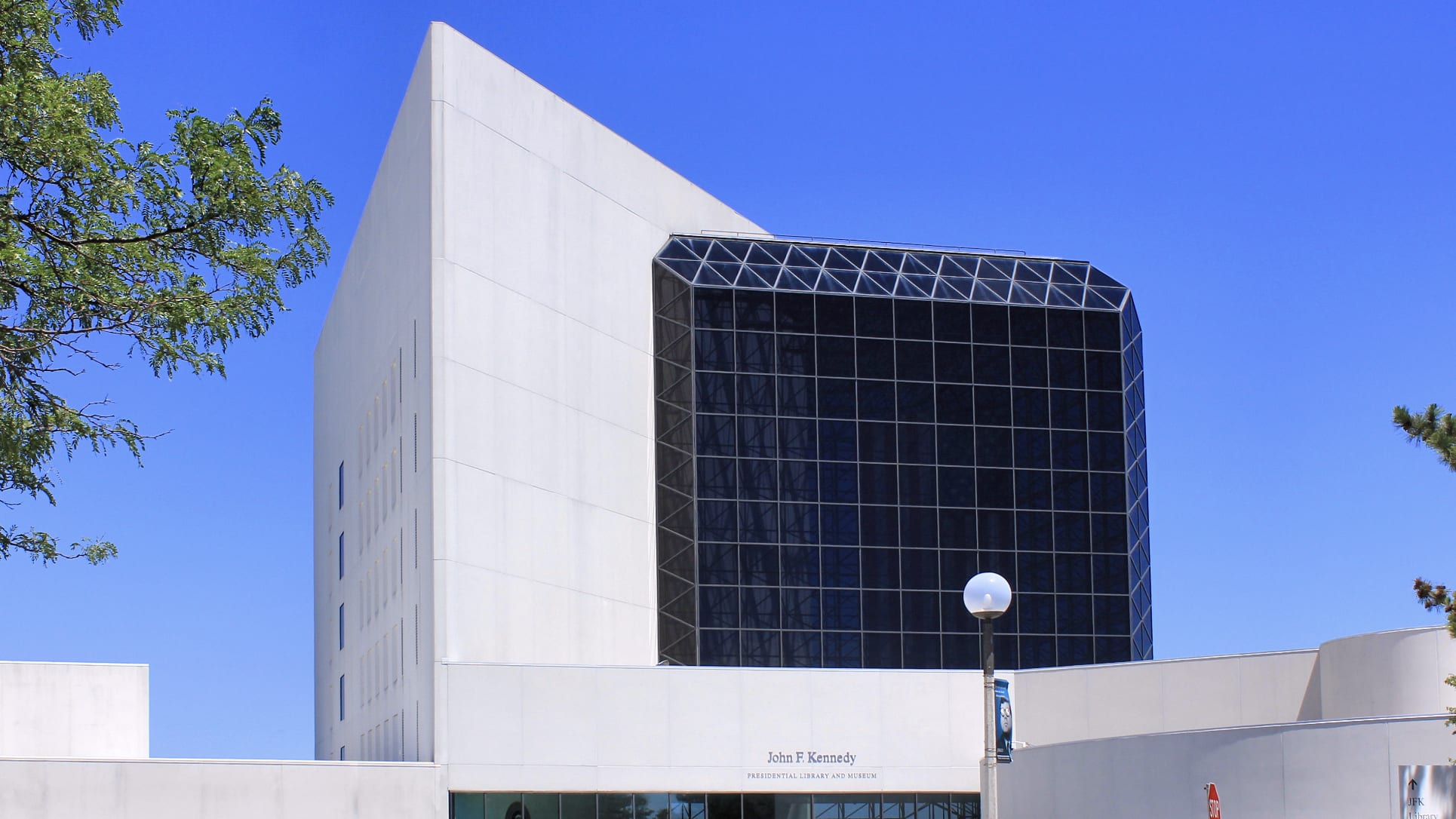
The building and the setting are striking: an I. M. Pei design out on Columbia Point with the harbor on three sides. We entered with the same anticipation we had brought to the other three. We were a little put off by the welcome. To put it in perspective: at Truman, Eisenhower, and Reagan, the staff had been warm and generous. Here, by contrast, the welcome was more reserved. Worth noting since it was so different from the pattern, but not enough to color the visit.
The library is well organized, with sections that walk you through the campaign, the presidency, and the family. Plenty to think about, and a great deal of historical material to set straight in our own minds.
The early years.
John Fitzgerald Kennedy was born May 29, 1917, in Brookline, Massachusetts, the second of nine children of Joseph and Rose Kennedy. He went to Harvard. With World War Two underway, he tried to enlist in the Army but was rejected for his back. He talked his way into the Navy and was eventually given command of a Patrol Torpedo boat, PT-109, in the South Pacific.
On the night of August 2, 1943, in the Solomon Islands, PT-109 was rammed and cut in half by a Japanese destroyer. Two of his crew were killed. Kennedy, despite serious back injuries of his own, swam for hours pulling a badly burned crewman by a life-jacket strap held in his teeth, until they reached a small island. He kept the survivors alive on coconuts and rainwater while he swam out at night looking for other PT boats. They were eventually rescued. He came home a war hero, and the story would be told and retold for the rest of his life.
After the war he ran for the House of Representatives from Massachusetts and was elected in 1946, taking office in 1947. He moved to the Senate in 1953. The same year, he married Jacqueline Bouvier. In 1957 he won the Pulitzer Prize for biography for Profiles in Courage.
The 1960 campaign.
Kennedy won the Democratic nomination in 1960 over Hubert Humphrey and Lyndon Johnson. He chose Johnson as his running mate, partly to balance the ticket and partly to carry the South.
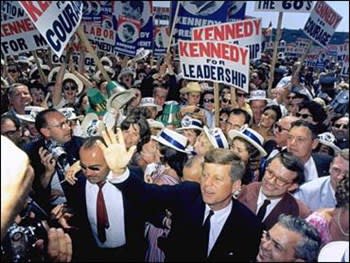
The 1960 race against Vice President Richard Nixon was close, and it included the first televised presidential debate in American history. On September 26, 1960, the two candidates met in Chicago in front of cameras. Those who watched on television tended to think Kennedy had won the debate. Those who heard it only on the radio tended to give it to Nixon. The visual was the verdict, and the importance of how a candidate looked on a screen has been with us ever since. A clip of that first debate is on YouTube (here). Kennedy was also the first Roman Catholic to win a major-party nomination, and his religion was a serious campaign issue right through to election day. He won by one of the narrowest popular-vote margins in American history, just 112,827 votes out of nearly 69 million cast. The Electoral College vote was 303 to 219, with 15 unpledged electors from Mississippi and Alabama going to Senator Harry F. Byrd of Virginia.
The inauguration.
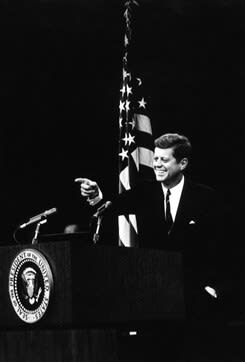
Inaugurated on January 20, 1961, Kennedy delivered one of the most quoted speeches in American history. The famous line:
"Ask not what your country can do for you, ask what you can do for your country."
He was the youngest man ever elected President of the United States. The full inaugural address is on YouTube (here).
The presidency.
The library walks you through it section by section.
The Bay of Pigs came first. In April 1961, less than three months into his term, a CIA-organized invasion of Cuba by anti-Castro Cuban exiles failed badly. Kennedy publicly took responsibility for the failure, and the experience reshaped how he engaged with his military and intelligence advisors. He would draw on that lesson the following year in a much more dangerous crisis.
In August 1961 the Soviets began building the Berlin Wall, sealing East Berlin off from the West. On June 26, 1963, Kennedy went to West Berlin and delivered the speech that closed with the line:
"All free men, wherever they may live, are citizens of Berlin, and, therefore, as a free man, I take pride in the words Ich bin ein Berliner."
The Berlin speech is on YouTube (here). It is worth watching for the size of the crowd alone.
In October 1962 came the Cuban Missile Crisis, thirteen days that took the world closer to nuclear war than it has ever been before or since. On October 14, a U-2 reconnaissance flight photographed Soviet missile installations being built in Cuba. Kennedy considered options that ranged from air strikes to a full invasion of the island, and chose instead a naval quarantine that gave Khrushchev room to back down. The crisis was resolved on October 28 with an agreement that the Soviets would withdraw the missiles in exchange for a public US pledge not to invade Cuba and a private US pledge to withdraw older missiles from Turkey. The Limited Test Ban Treaty signed the following August, banning atmospheric nuclear weapons tests, came directly out of the lessons learned during those two weeks.
Civil Rights.
By 1963 the civil rights movement was reshaping the country. In 1960 four Black college students in North Carolina had sat in at a Whites-only Woolworth's lunch counter, launching a wave of similar protests. In May 1961 a group of Freedom Riders left Washington to integrate Greyhound bus stations across the South. The administration was repeatedly pulled into the use of federal force, including federalizing the Alabama National Guard in June 1963 to enforce the integration of the University of Alabama. That same evening, June 11, 1963, Kennedy gave a televised address to the nation, calling civil rights "a moral issue ... as old as the Scriptures and as clear as the American Constitution." His administration sent the bill to Congress that, after his death, became the Civil Rights Act of 1964.
The Space Race.
On May 25, 1961, only six weeks after Yuri Gagarin had become the first man in space, Kennedy stood before Congress and made the case:
"I believe that this nation should commit itself to achieving the goal, before this decade is out, of landing a man on the Moon and returning him safely to the Earth."
He appealed to the spirit of adventure, to patriotic pride, and to the cause of freedom in the deepening Cold War. The country responded with one of the largest mobilizations of resources and scientific talent in American history. Eight years later, on July 20, 1969, two American astronauts walked on the Moon. Kennedy did not live to see it. But he set the goal and the deadline that drove a nation to do it.
Robert Kennedy.
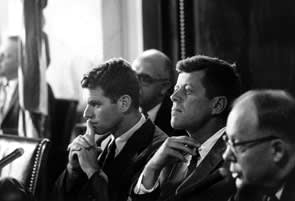
A full section of the library is dedicated to Robert Kennedy, who served as his older brother's Attorney General. He took organized crime seriously. He said:
"To meet the challenge of our times, so that we can later look back upon this era not as one of which we need be ashamed but as a turning point on the way to a better America, we must first defeat the enemy within."
The Department of Justice's pursuit of organized crime in those years built the foundation that has defined federal prosecution ever since. Bobby was also a central figure in the Cuban Missile Crisis, conducting the backchannel negotiations with Soviet Ambassador Dobrynin that allowed Khrushchev a face-saving exit. He was assassinated himself in June 1968, while running for the presidency.
The Oval Office.
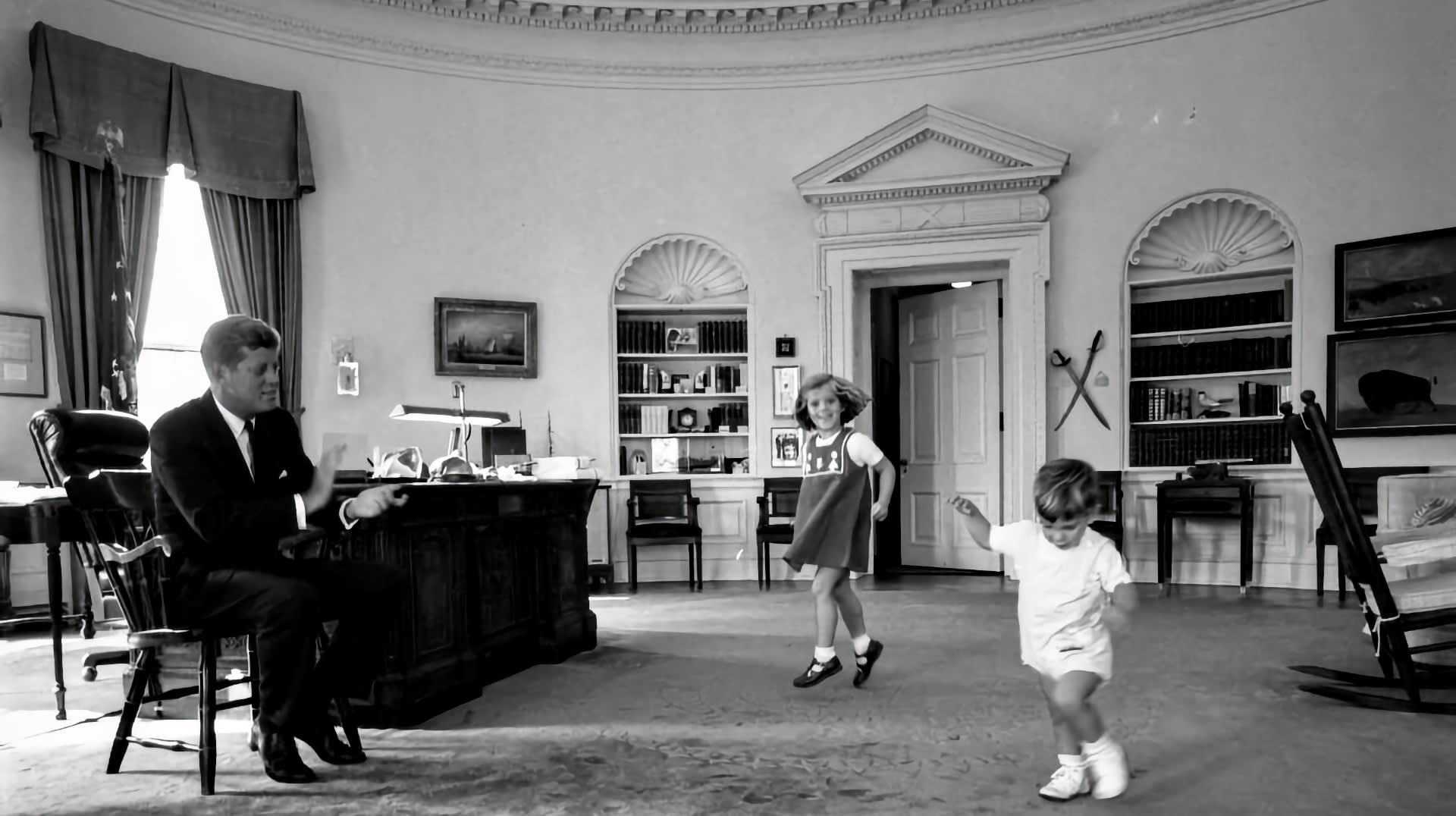
The library has a working replica of Kennedy's Oval Office, with the Resolute desk that has been used by most presidents since Rutherford B. Hayes. The room is set up as it was during his presidency, including many of his personal items.
Jacqueline Kennedy.
Jackie's exhibit covers her work as First Lady, particularly her restoration of the White House in 1961 and 1962, and her famous televised tour on February 14, 1962, which drew an estimated 80 million viewers, the largest audience for a television program to that point.
The Kennedy family.
"When my great-grandfather left here to become a cooper in East Boston, he carried nothing with him except two things: a strong religious faith and a strong desire for liberty. I am glad to say that all of his great-grandchildren have valued that inheritance." — President Kennedy to the people of New Ross, Ireland, June 1963
The library's family material is genuine and warm, with intimate photographs of the president with Jackie, Caroline, and John Jr.
Dallas.
On November 22, 1963, in Dallas, Texas, Kennedy was shot and killed while riding in a motorcade with Jackie and the Governor of Texas. He was forty-six years old. He was buried at Arlington National Cemetery, where Jackie lit the eternal flame at his grave.
A note on the visit.
The library is well organized and the historical material is excellent. We came away thinking the exhibits felt less updated than the other libraries we had visited — less digital, less interactive, more in the museum-traditional mode. Is it worth a visit? Yes. The man and the events deserve the time.
In the morning we packed up and drove west across Massachusetts into New York, headed for Hyde Park and the Roosevelt Library.