Dateline November 9, 2022, Cairo, the Pyramids of Giza
Our flight from Jordan was short, and before long we were through passport control, our bags in hand, and out the door looking for the driver who would carry us to our hotel by the Giza pyramids.
Driving in Cairo. Cairo traffic is a story all its own. There seemed to be no order and no rules; we asked our driver how he had trained, and he grinned, "I drive like I'm in a go-cart." It was alarming at times, but the trick, we found, was not to play backseat driver and simply to close your eyes. There appear to be no left turns at all. You drive past where you mean to go, make a U-turn, and come back to a right. He gave us a fact or two as well: the city, he said, runs to about a hundred and seventy-five square miles and ten million people, the city proper alone. We put that against New York's five boroughs, three hundred-odd square miles and eight million, and decided Cairo was roughly twice as crowded.
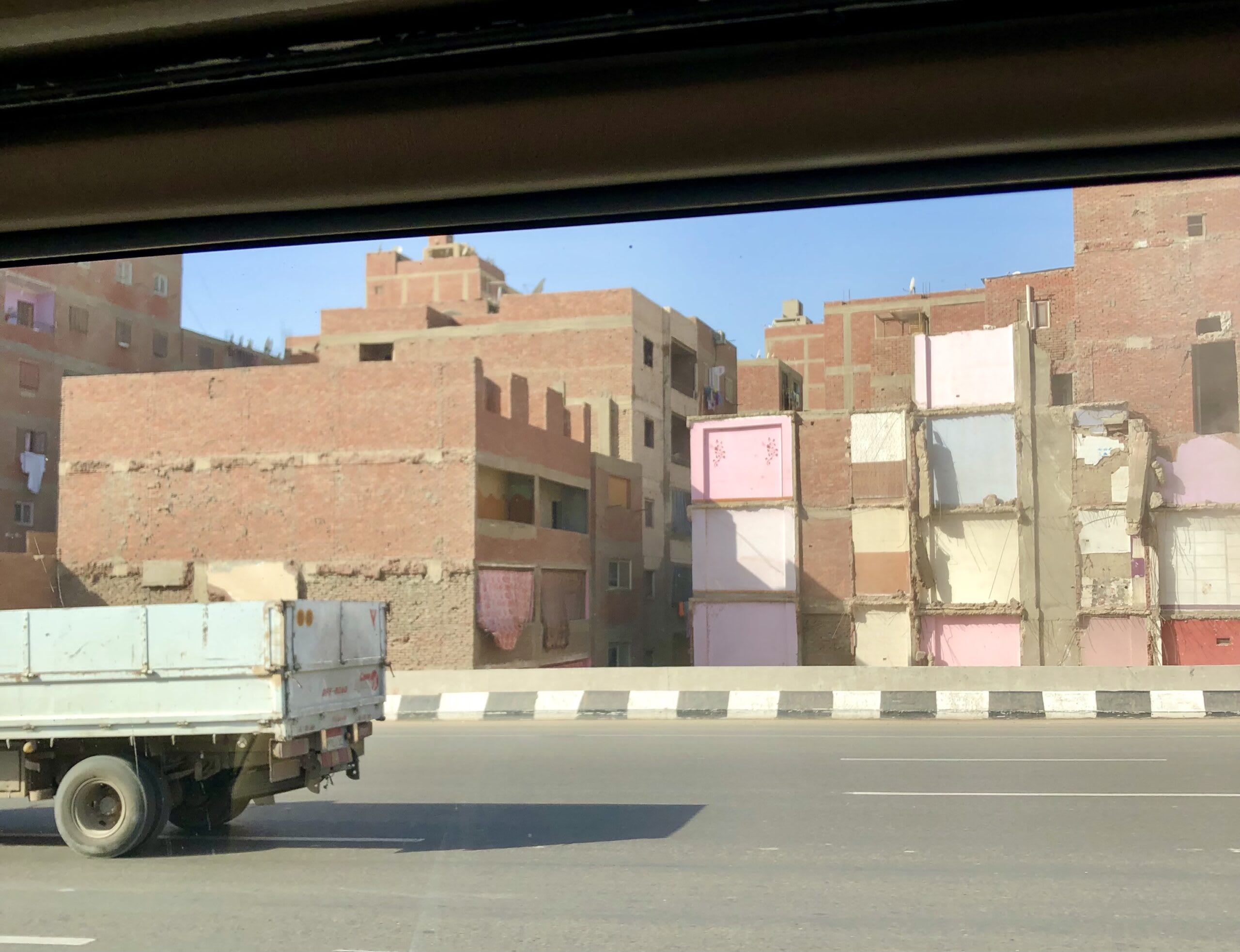
The Giza side of the Nile. Once we crossed the river the road widened, and it had been widened by shearing the fronts clean off the buildings; you could see the wallboard and the rooms laid open where they had been cut. The residents, we were told, had been rehoused, though it was a sad business all the same, some of them moved away from neighbors they had lived beside all their lives.
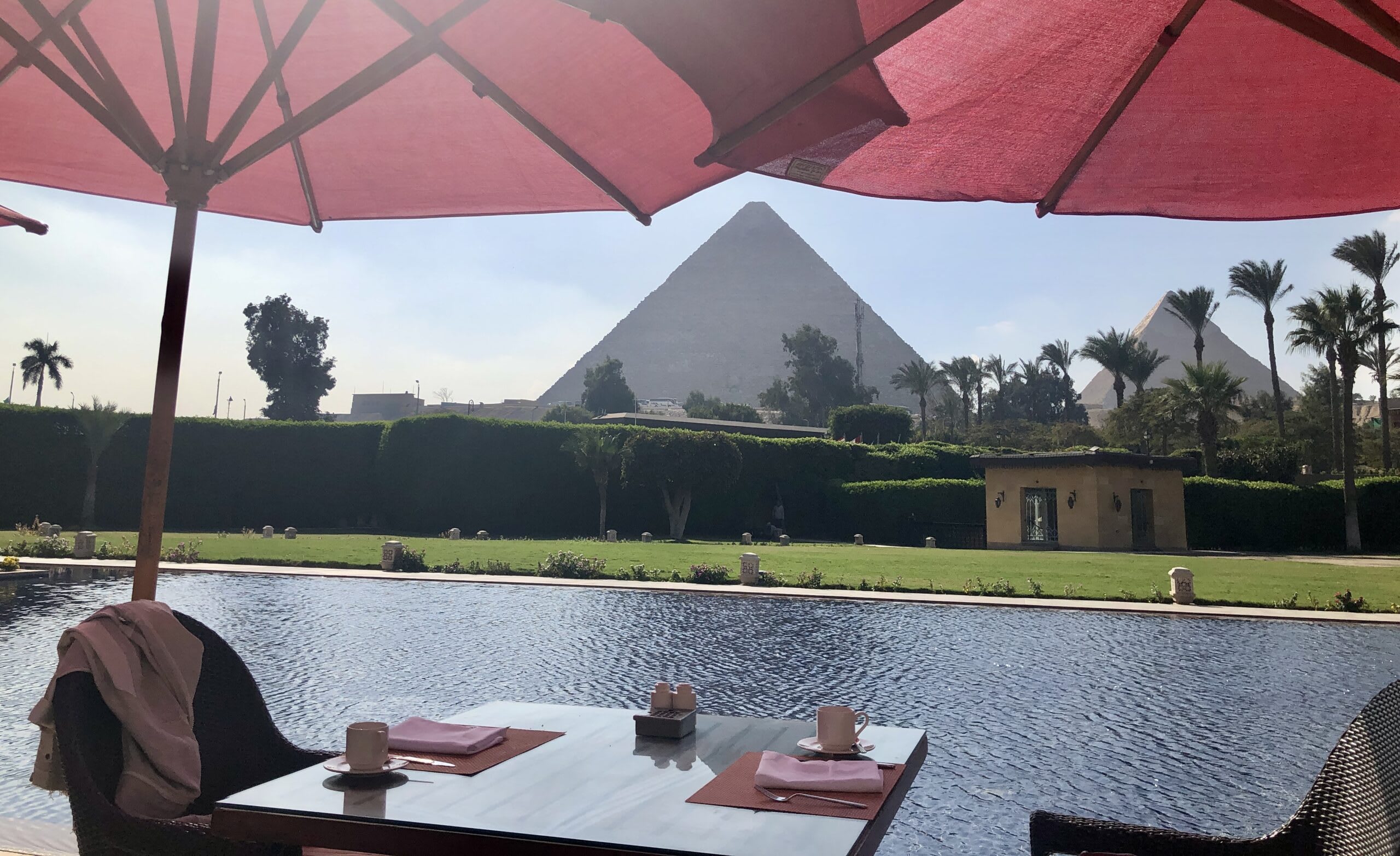
The Mena House. As we reached Giza we caught our first pyramid in the distance, and Janice got chills. Our hotel, the Marriott Mena House, stands almost at the foot of the Great Pyramid, and it has a history to match its view. It began in 1869 as a khedival hunting lodge, a two-story affair they called the Mud Hut, built for the Khedive Ismail. A British couple, the Heads, bought it in 1883 for a home and named it after Mena, or Menes, the king said to have founded the first Egyptian dynasty; another English couple, the Locke Kings, turned it into a hotel that opened in 1886. Through both world wars it housed and tended British and Commonwealth troops; Churchill stayed often, and so did Montgomery, and their suites still carry their names. In 1943 it hosted the Cairo Conference, where Roosevelt, Churchill, and Chiang Kai-shek met, and in December 1977 it was the setting for the first Egypt-Israel peace talks, the Mena House Conference, that helped open the road to Camp David the following year. We woke early the next morning and got chills all over again, just looking across at the Great Pyramid over breakfast.
Our guide, Sam. Janice has a knack on our trips for turning up local guides who truly know their ground, and Cairo was no exception. Ours met us at the front desk and introduced himself as Sam English, though his name, we soon learned, was Sameh Fawzi. You will come to know Sam well.
The Giza complex. We drove to the Giza necropolis, the great field of tombs and temples, and Sam laid out how the three pyramids fit together: the Great Pyramid of Khufu, then Khafre's, then Menkaure's. Khufu, second king of the fourth dynasty, raised the oldest and northernmost of the three. His complex once held a mortuary temple, where the king was prepared for burial, linked by a long causeway to a valley temple down at the edge of the Nile floodplain.
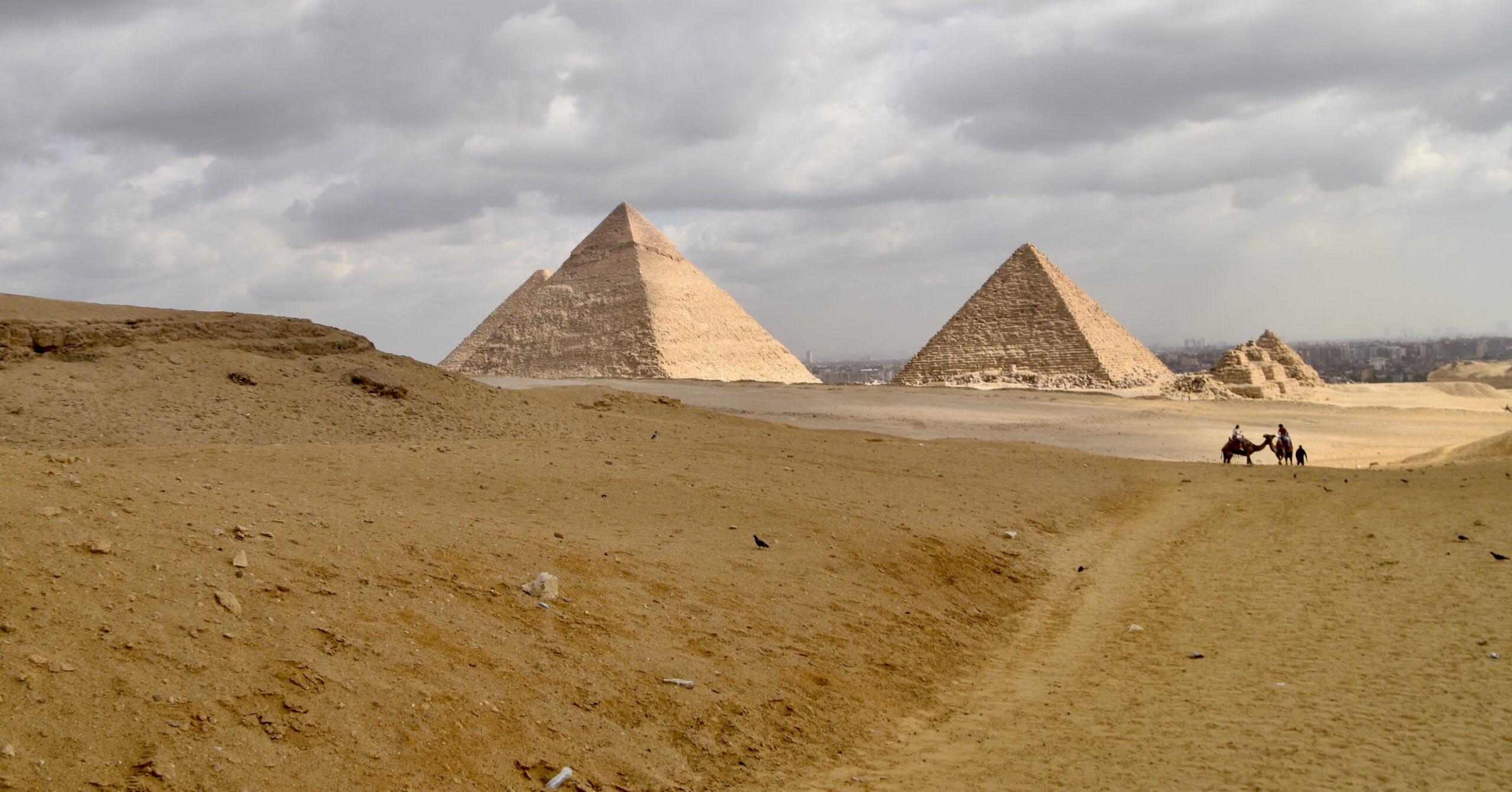
The Great Pyramid. The Great Pyramid went up in the mid-2500s BC, in Khufu's reign, and it is the largest in all Egypt: something like 2.3 million blocks, by one reckoning five and a half million tons of limestone, eight thousand tons of granite, and half a million tons of mortar. How it was built is still argued. The old picture was a hundred thousand men laboring through the months when the flooded Nile stopped the farming; more recent work suggests a smaller, steadier crew, perhaps twenty thousand with all their bakers and physicians and priests, would have sufficed. The core is local yellow limestone, the casing, now almost wholly stripped away, and the inner passages a finer pale stone, and the burial chamber great blocks of granite. The precision is the marvel: the angles, they say, are nowhere more than a degree off.
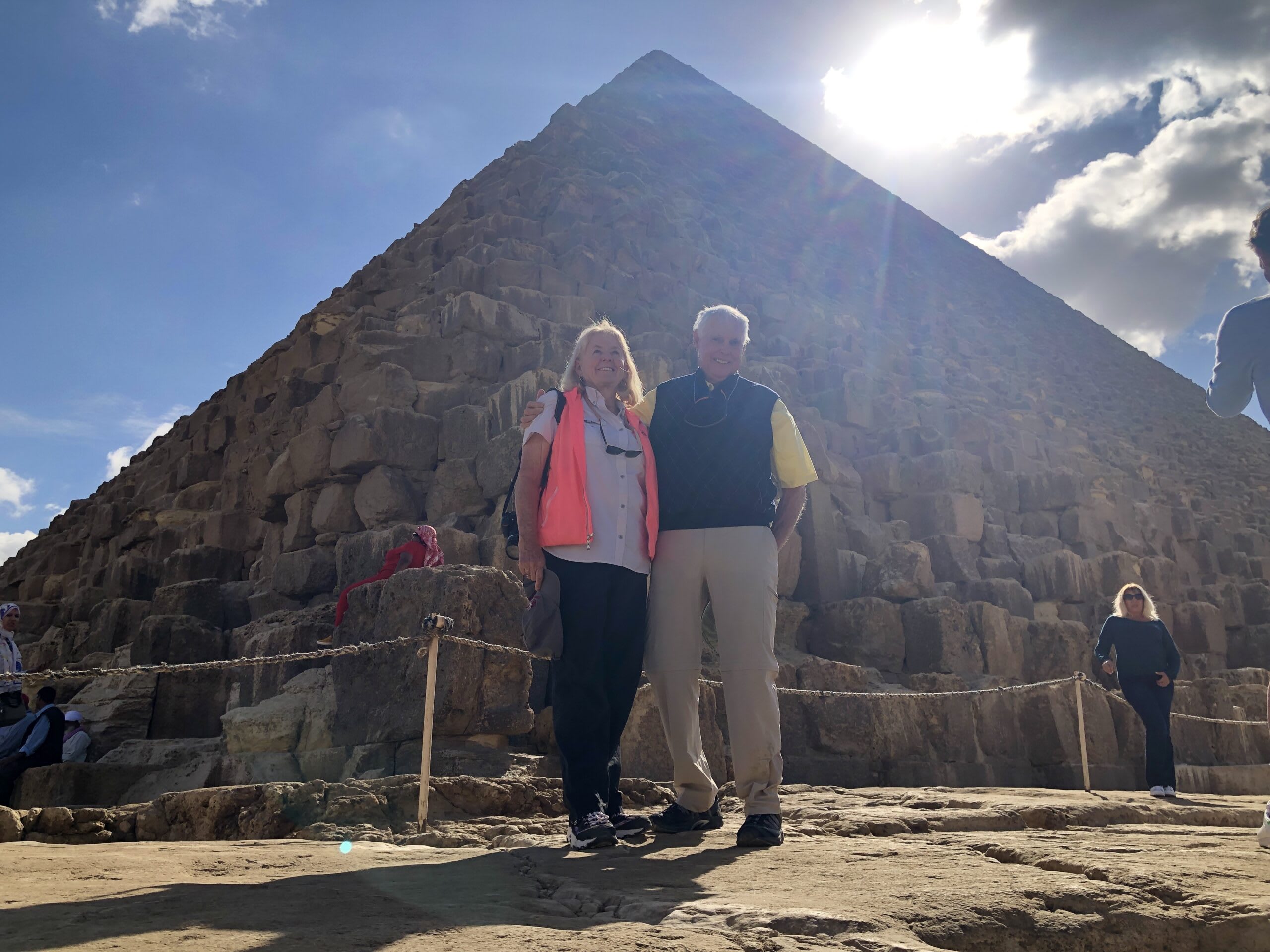
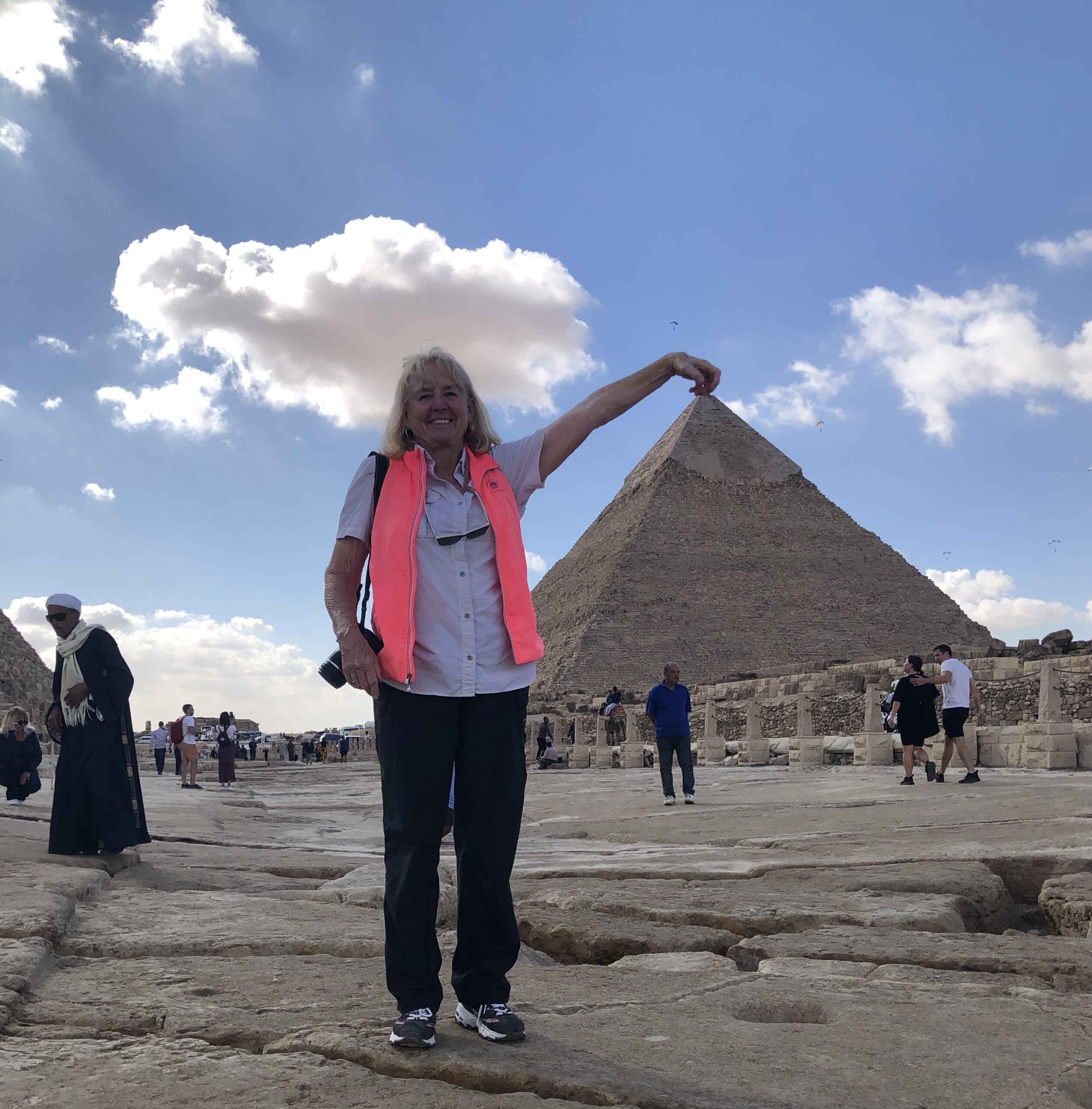
Standing at its foot, we were simply awestruck at the size of it. Sam offered to take us inside for a fee but said the chamber held nothing worth seeing, and that we would do far better later, at a pyramid whose interior was remarkable. He knew exactly where to stand us for photographs, some of them gloriously hokey.
To camel or not to camel. We drove around to the camels. We had been booked for as much as forty-five minutes; ten or fifteen made a great deal more sense. The man running the camel concession looked as though he had walked straight off a film set, perfect.
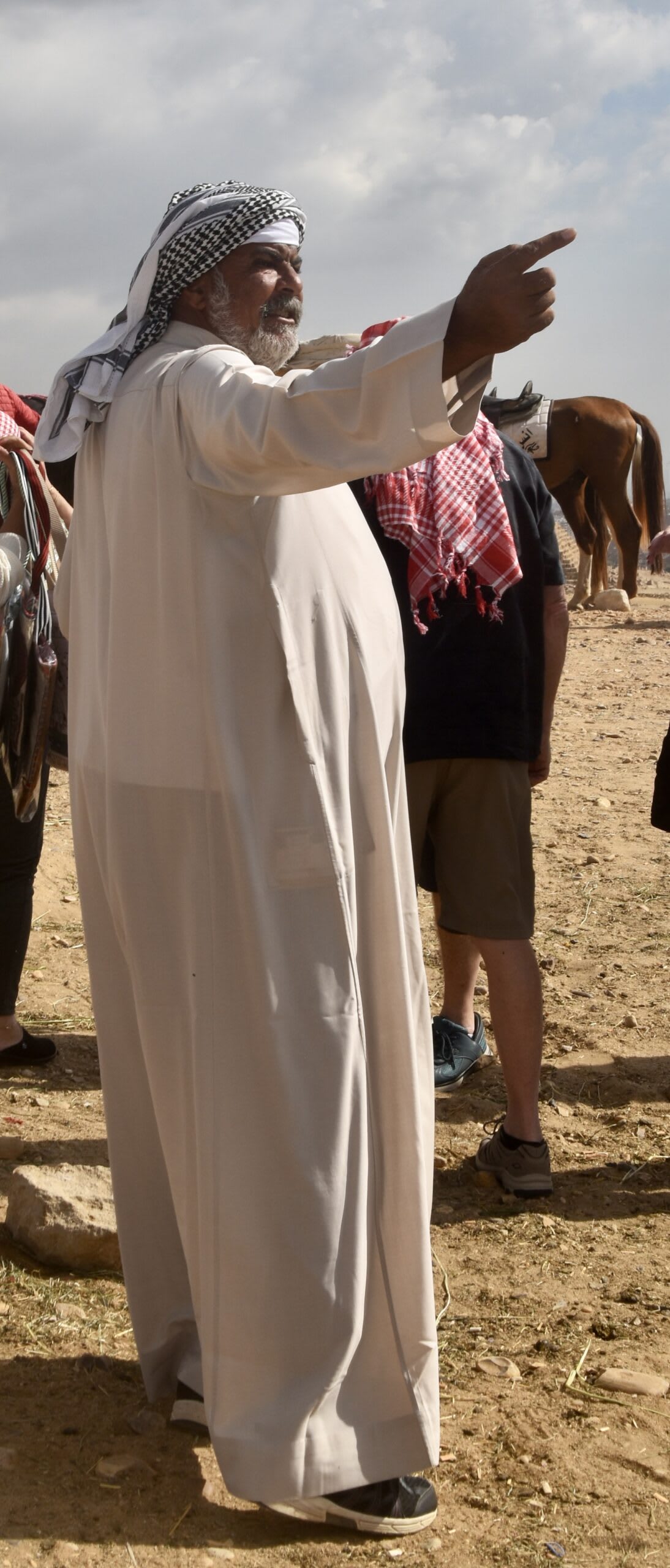
Sam helped John aboard. A camel rises with its back legs first, so you pitch forward as though you'll go clean over its head, and then the front legs straighten and up you go. A comical business.
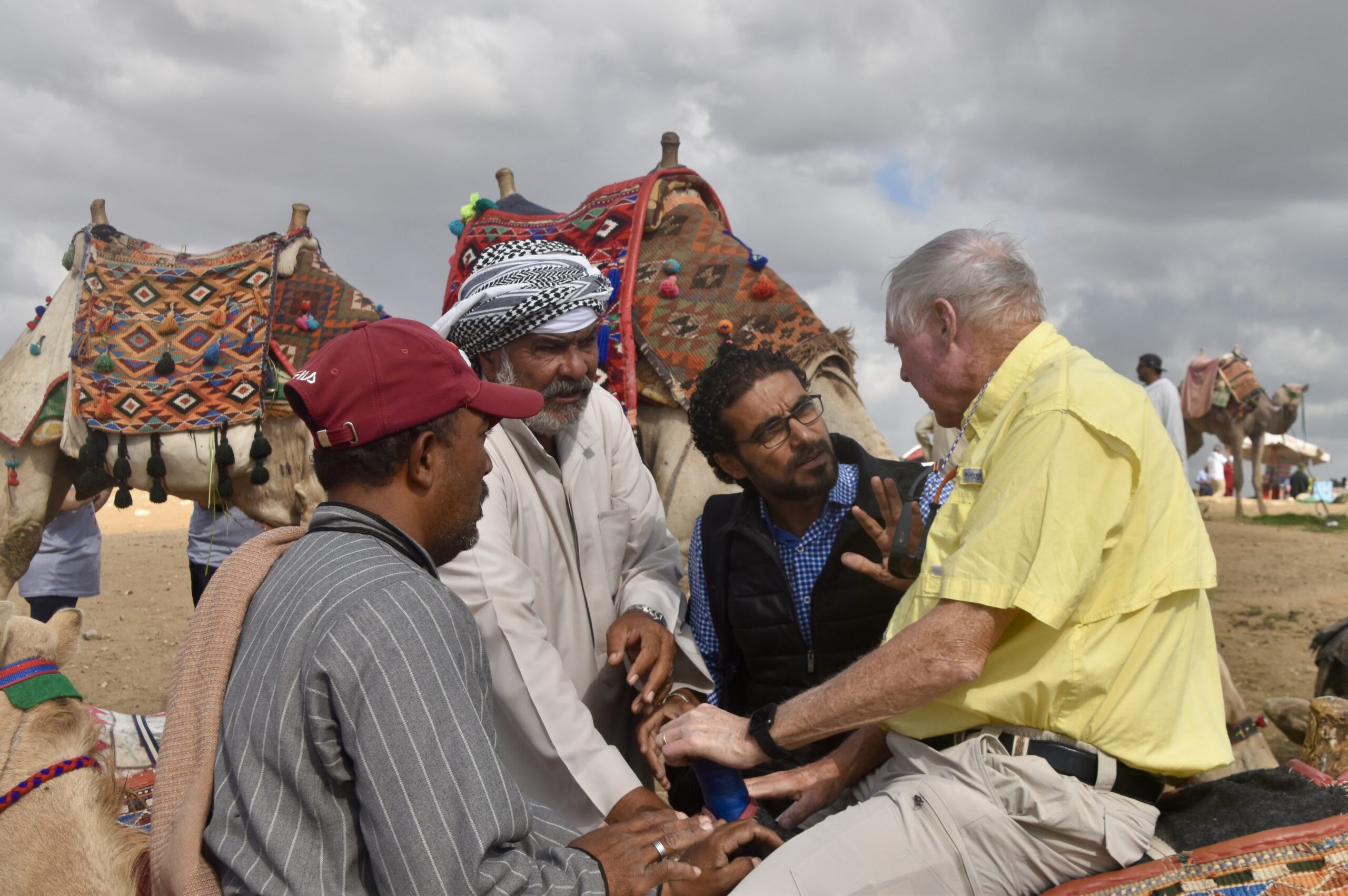
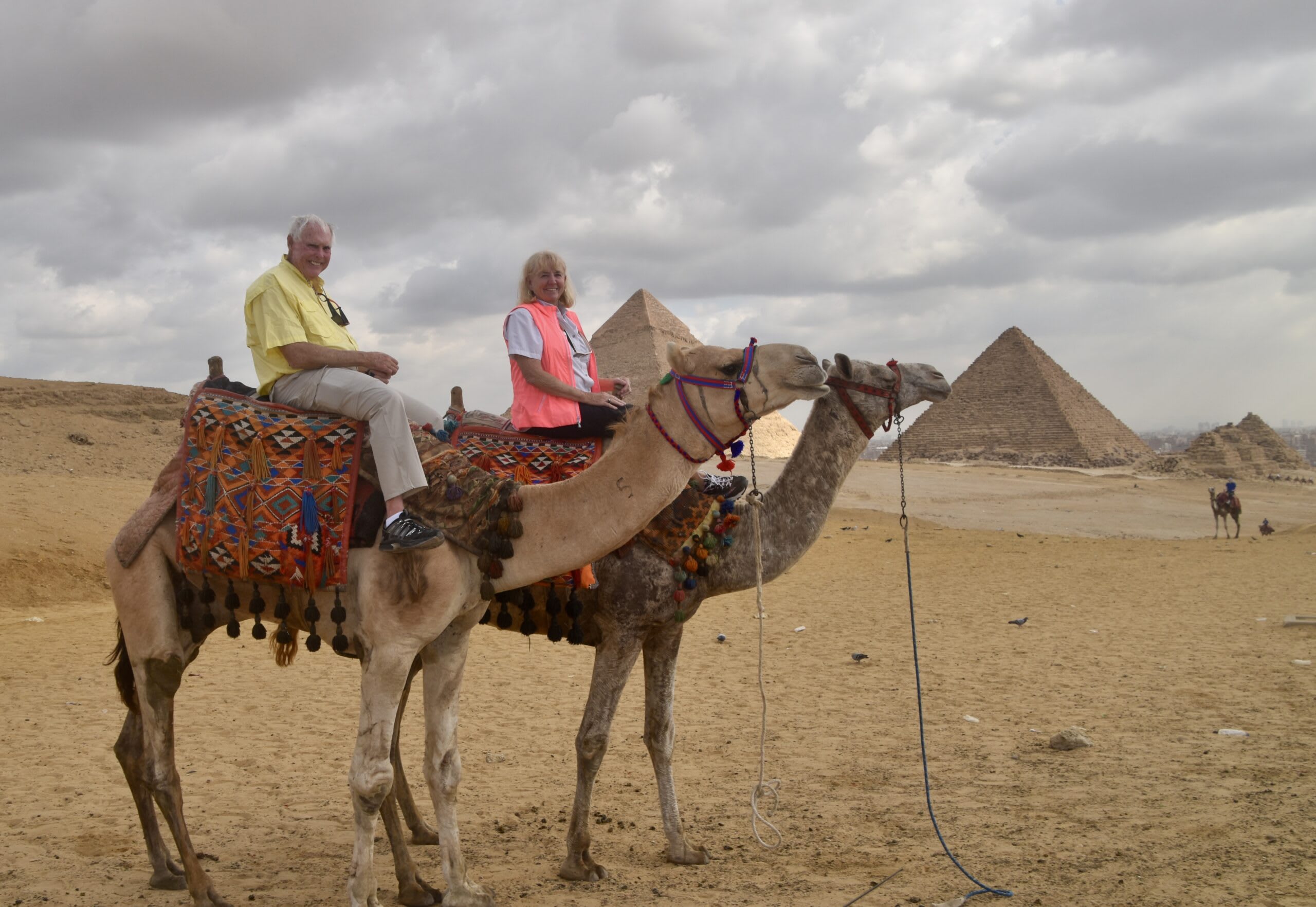
Out on the sand by the Great Pyramid, you feel a part of history itself, here at the very beginnings of civilization. A true Kodak moment.
The Great Sphinx. Nearby crouches the Great Sphinx, one of the largest sculptures on earth, about two hundred and forty feet long and sixty-six high, a lion's body under a human head in the royal headdress. Whose face it wears, no one can say for certain, though the evidence points to the reign of Khafre, around 2500 BC. It was cut from a single mass of limestone, and traces of pigment suggest the whole of it was once painted. By one estimate a hundred workers, with stone hammers and copper chisels, would have needed some three years.
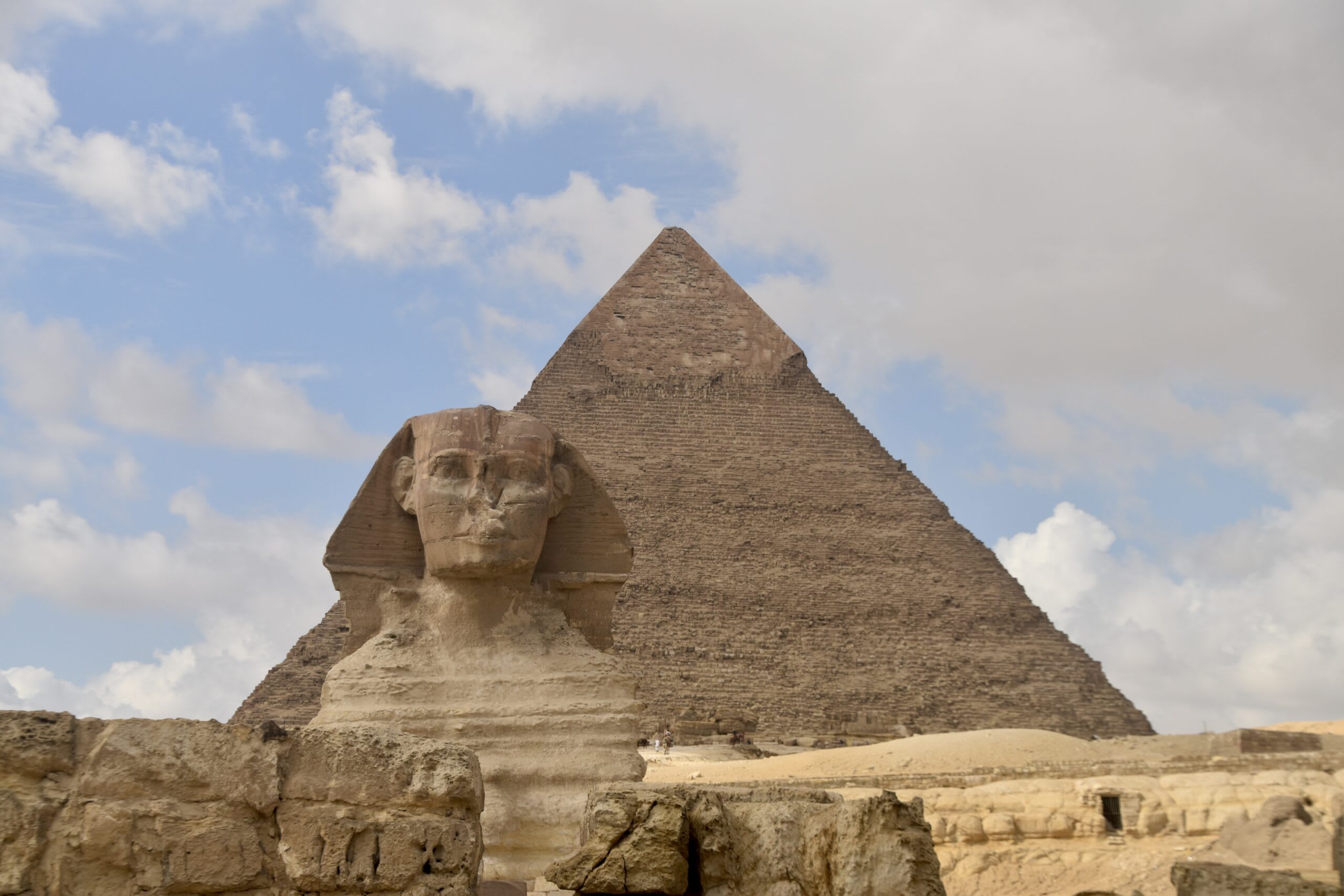
As for the famous missing nose, a fifteenth-century Egyptian writer recorded that a Sufi named Sa'im al-Dahr knocked it off in 1378, enraged to find peasants making offerings to the Sphinx for a good flood and harvest, and was put to death for the vandalism. Whether it happened quite that way, who can say; it may simply be a good story.
The Christians of Egypt. It is worth pausing on Sam himself, who is a Coptic Christian and gave us a moving account of his people. Christianity came to Egypt with Saint Mark, who preached at Alexandria in the first century. Under the Romans it took hold, and once the Emperor Constantine embraced the faith it became the religion of Egypt, until the Muslim conquest in 641. After that the Copts became second-class citizens, and were persecuted, on and off, for centuries. Of the present, Sam spoke plainly: the hard years, as he told it, ran through Mubarak and worst of all under Morsi and the Muslim Brotherhood, and since General el-Sisi took power, he said, Christians have been treated with far more respect. That was his account, given straight, and we were glad to hear it from a man who lives it.
With Giza behind us, Sam pointed the car south, toward an older Egypt still to come, Saqqara and Memphis.